
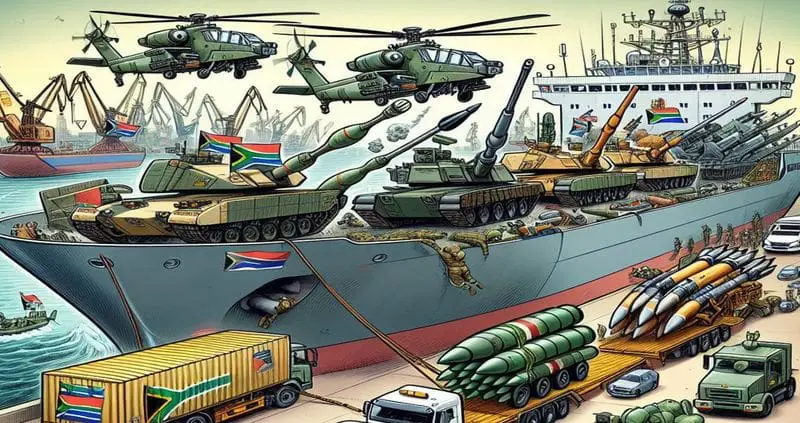
SA accused of hypocrisy for exporting arms to military juntas and violators of human rights
The South African government has been accused of breaking its own laws and violating its commitments to “silencing the guns”, by selling arms to military juntas or states which are committing human rights abuses.
South Africa is selling arms to the African countries of Mali, Guinea, Gabon and Burkina Faso – all which are controlled by military governments which seized power in coups – and to Saudi Arabia and the United Arab Emirates (UAE), which have been accused by the United Nations of human rights abuses, according to the Southern Africa Litigation Centre (SALC) in a report published on Tuesday, 21 October 2025.
The report – The Hypocrisy of South Africa’s Arms Exports – by the centre’s Atilla Kisla, says that these arms exports by South Africa are “not aligned with its political claims, regulatory frameworks and latest jurisprudence”.
It notes: “South Africa has built much of its post-apartheid identity around being a champion of human rights, peace and democracy – both in Africa and on the world stage.
“From ‘silencing the guns’ in Africa to standing up for international law at the United Nations, its official rhetoric consistently promotes peace over violence,” the report says.
And yet “it authorises arms exports to governments engaged in… repression and war”.
Blind eye
Kisla notes that “every bullet, tank or missile that leaves South African soil… is supposed to pass through the watchful eyes of… the National Conventional Arms Control Committee (NCACC) – the official gatekeeper of South Africa’s arms exports.”
The NCACC is chaired by Khumbudzo Ntshavheni, the minister in the Presidency, and also comprises six other Cabinet ministers and four deputy ministers.
Kisla notes that the NCACC’s governing legislation forbids it from authorising the sale of South African arms to countries where the arms could fuel repression, or be used to violate human rights or international humanitarian law; or if the recipient government is under military rule or is credibly accused of international crimes.
Yet in late 2021 – even after a military junta seized full power in Myanmar – the NCACC still approved permits for arms exports to Myanmar, “directly contradicting South Africa’s stated foreign policy and its vote at the United Nations in favour of an arms embargo”.
The SALC brought a case against the NCACC over its approval of R215-million worth of arms sales to Myanmar between 2017 and 2021, a time when the prosecutor of the International Criminal Court had requested an investigation of the country and the International Court of Justice had issued provisional measures against Myanmar for alleged genocide against the Rohingya minority.
Kisla notes that in July 2024, the Gauteng High Court gave a landmark ruling in favour of the SALC. The court set aside the NCACC permits it had granted for arms sales to Myanmar and ruled that the NCACC was obliged under the law to suspend permits that allow arms transfers to states committing grave human rights violations, international crimes, or which had governments that had come to power through an unconstitutional change of government – which includes military coups, as Myanmar had in February 2021.
Kisla says that NCACC reports from 2022 until June 2025 reveal that the NCACC continued to approve arms sales to several African countries even after they had undergone coups.
Sipho Mashaba, acting head of the NCACC Secretariat, said that under the National Conventional Arms Control Act, he could not disclose any information about the business of the NCACC without the committee’s permission, which he had not been granted.
Besides, he said, some countries (mentioned in the report) were “under judicial consideration” and so these cases could not be publicly discussed.
Mashaba appeared to be referring to the ongoing review case brought by SALC and Open Secrets to the High Court in 2021 seeking an order that the decisions by the NCACC to issue permits for arms exports to Saudi Arabia and the UAE were unlawful.
Coups and combat vehicles
On 5 September 2021, Guinea’s President Alpha Condé was ousted in a military coup led by Colonel Mamady Doumbouya. Both the African Union and the Economic Community of West African States (Ecowas) suspended Guinea because of the coup. Yet Kisla says that in 2022 the NCACC approved the sale to Guinea of two armoured combat vehicles for a total of R26.1-million and in 2023 another two armoured combat vehicles, also for R26.1-million.
These sales were “particularly concerning because these are not defensive items… They are frontline vehicles designed for combat and crowd control. Both in 2022 and 2023 the country was ruled by the junta that arrested opposition members and banned demonstrations,” Kisla said.
The report noted that Burkina Faso had experienced two military coups in January and October 2022, the first deposing President Roch Kaboré and the second bringing Captain Ibrahim Traoré to power . The AU and Ecowas suspended the country.