
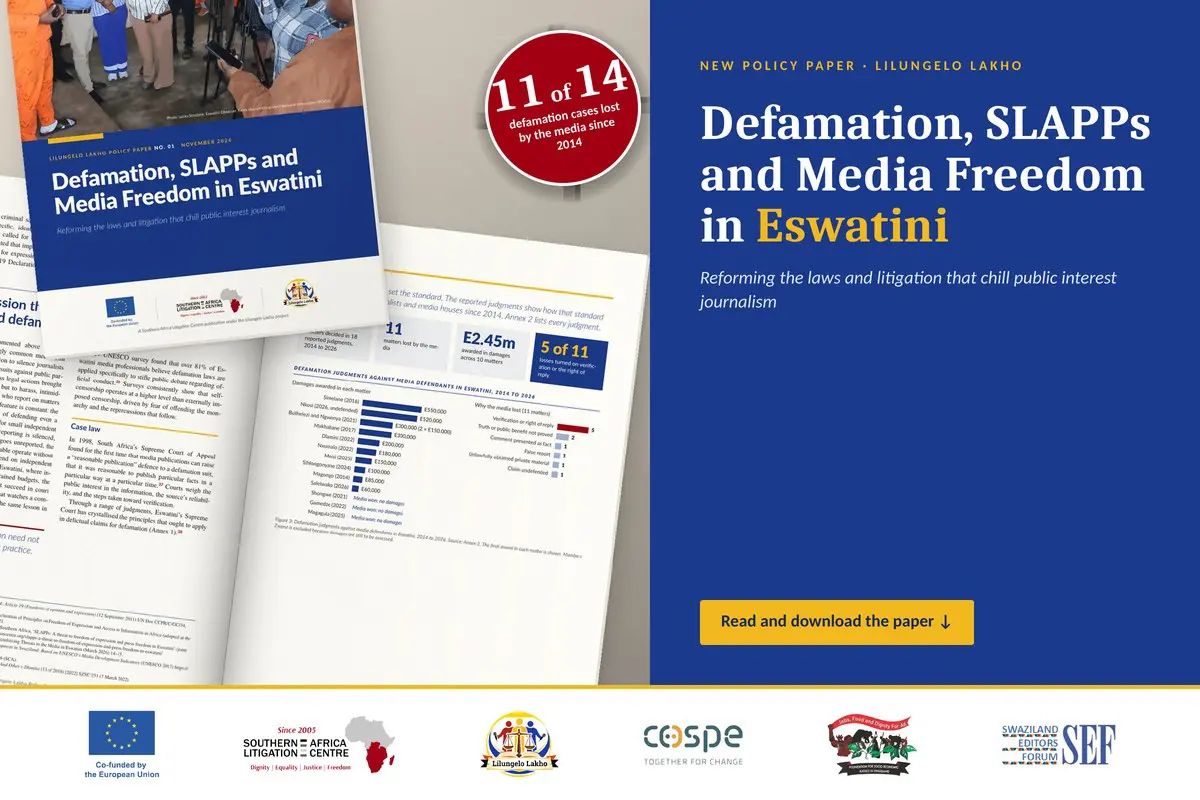
Eswatini’s media lost 11 of 14 defamation cases since 2014. A new SALC policy paper sets out the laws and lawsuits that chill journalism, and how to fix them.
Eswatini’s independent media works under layered pressure. Licensing and proscription laws, criminal defamation, contempt of court and a cybercrime law that treats defamation as cyberstalking all remain in force. Alongside them, defamation suits with escalating damages and economic pressure push newsrooms towards self-censorship. Eswatini now ranks 101st of 180 countries on the 2026 World Press Freedom Index.
In this policy paper, the Southern Africa Litigation Centre examines every reported defamation judgment involving the media in Eswatini from 2014 to 2026, alongside laws that restrict the press and reforms other countries have adopted to counter strategic lawsuits against public participation (SLAPPs).
Key findings
- The media lost 11 of 14 defamation matters decided by the courts since 2014.
- Courts awarded E2.45 million in damages against media defendants, with single awards ranging from E60,000 to E550,000.
- In 5 of the 11 losses, the case turned on verification or the right of reply.
- Laws from 1963 and 1968 still require a licence to publish and allow a Minister to ban publications. Criminal defamation remains an offence, although courts in Zimbabwe, Kenya and Lesotho have struck it down.
- No Southern African country has yet adopted anti-SLAPP legislation
What the paper recommends
- Parliament and government: adopt anti-SLAPP legislation with early dismissal of abusive claims; repeal or narrow the laws that criminalise expression, including criminal defamation; and require transparency of media ownership.
- The courts: strike out abusive claims early, keep damages proportionate, and apply the reasonable-publication principles consistently.
- Civil society and the media: make self-regulation work, pool a legal defence fund, adopt right-of-reply protocols and build pro bono defence partnerships.
- International and regional bodies: raise these reforms in dialogue with Eswatini, observe defamation hearings and follow up on African Commission and UN findings.
The paper was launched in an online webinar on 18 November 2026 with UNESCO, the Committee to Protect Journalists, journalism educators, editors and the Lilungelo Lakho partners.
Suggested citation: Southern Africa Litigation Centre, Defamation, SLAPPs and Media Freedom in Eswatini (Lilungelo Lakho Policy Paper No. 01, November 2026
[Download the policy paper (PDF)]
Disclaimer
This publication was co-funded by the European Union under the project “Advancing Civic Space, Human Rights and Access to Justice in Eswatini” (Lilungelo Lakho), implemented by COSPE, the Foundation for Socio-Economic Justice, the Southern Africa Litigation Centre and the Swaziland Editors Forum. Its contents are the sole responsibility of the Southern Africa Litigation Centre and do not necessarily reflect the views of the European Union.