
The Standard Zimbabwe (8 November 2026)
Imagine enjoying the start of a new year, making New Year’s resolutions, tending your garden and livestock, then suddenly finding out the water you and your community have been relying on has been contaminated with toxic chemicals. This probably sent a worrying shiver through the area.
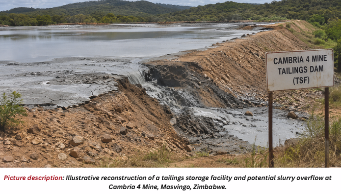
At the beginning of 2025, heavy rainfall caused a structural failure at the Cambria 4 mine’s tailings dam in Masvingo. The severe weather caused the mine’s tailings dam to overflow. The overflow released highly toxic substances into a stream that flows into the Shashe dam.
Environmental Management Agency (EMA) ordered Cambria 4 Mine to halt operations. Residents were reportedly worried about long-term effects on their livelihoods, as the river is a community resource.
To show how large and important the Shashe waters are, the river flows into the Runde River, which empties into the Save River inside Gonarezhou National Park.
The polluted water killed fish, livestock and crops in the surrounding areas. Water samples collected showed a rise in pH levels, likely due to sodium hydroxide contamination. The water samples also showed traces of cyanide, prompting immediate action to cease operations pending the implementation of pollution-control measures and the issuance of an environmental protection order.
This Cambria 4 incident shows how a failure in a mining operation can become an environmental problem. Especially where communities depend on shared water resources and this affected them negatively.
Mining in Zimbabwe.
Zimbabwe’s mining sector is one of the main sectors of its economy, alongside agriculture and manufacturing.
In March 2026, it was reported that Zimbabwe’s mining sector is highly diversified, with close to 40 different minerals. Key minerals include platinum group metals, chrome, gold, coal, lithium, graphite and diamonds. Mining is an engine of economic growth, industrialisation and employment.
But behind the language of investment and mineral wealth is a less desirable part of the mining industry. The waste left behind after valuable minerals have been extracted. For communities living along mining operations, this waste affects their health, livelihoods, water and land.
One environmental risk associated with mining is managing mine tailings. According to the United Nations Officer for Disaster Risk Reduction, tailings are the fine-grained waste material remaining after the metals and minerals recoverable from processed soil or rock have been extracted. They are the finely ground waste materials left after minerals have been processed and extracted, and they are stored in tailings storage facilities or tailings dams. Depending on the minerals processed and the methods and chemicals used, tailings can contaminate water and soil.
As we have seen at Cambria 4 mine’s tailings dam spill, when a tailings dam fails, overflows or leaks, the consequences can extend well beyond the boundaries of the mine.
Who bears the cost?
When rivers become contaminated, households lose access to clean water for drinking, cooking, livestock and agriculture. Farmers face uncertainty about whether their crops and soils have been affected. Fishing communities lose income and food sources. Families may have to travel farther to access alternative water supplies or pay for water they previously obtained from local sources. These costs are borne by the communities, not always by the mining companies. People with the least influence over mining decisions are ultimately expected to adapt to the consequences.
The problem is not simply the absence of laws.
Zimbabwe has an environmental legal framework. The Environmental Management Act [Chapter 20:27] provides an important foundation for environmental protection and accountability. Section 4 recognises the right to a clean environment that is not harmful to health and the right of access to environmental information. It also establishes principles requiring public participation in environmental governance and placing people and their needs at the centre of environmental management.
The Act provides that a person responsible for pollution or environmental degradation should meet the cost of remedying the damage, including resulting adverse health effects, and the costs of preventing and controlling further pollution. This principle is significant because it challenges the idea that environmental clean-up should automatically become a public expense.
The Cambria 4 tailing dam incident raises questions about the effectiveness of environmental risk assessments, the adequacy of emergency containment infrastructure, the frequency of inspections and whether regulators have sufficient capacity to monitor mining operations.
It also raises questions about the consequences mining operators face for breaching environmental protection requirements. An environmental protection order is an important regulatory intervention, but it is only part of the accountability process. Communities also need to know whether pollution was contained, whether affected water sources were restored, whether losses were assessed and whether those responsible met the costs of remediation.
Also, what happens when mining companies close, restructure, become insolvent or leave behind facilities that require long-term maintenance? Who takes responsibility for monitoring an abandoned tailings dam? Who pays to treat contaminated water or restore damaged land? And what happens when the company that generated the waste can no longer be held accountable?
These questions expose a weakness in mining governance approaches that focus predominantly on current production and compliance. Closure and rehabilitation cannot be treated as administrative exercises that companies complete when commercial operations end.
The right to access to information and remedy.
Perhaps one of the most overlooked aspects of tailings dam governance is the position of affected communities. Communities are often expected to live with the consequences of mining decisions without having meaningful access to the information needed to understand the risks.
Zimbabwe’s Environmental Management Act recognises access to environmental information and participation as important environmental governance principles. The constitutional framework also protects environmental rights and provides for access to information in relevant circumstances. But can communities access these rights promptly and use this information to seek remedy?
Access to information must result in access to justice. This is why organisations such as the Southern Africa Litigation Centre have been working alongside communities affected by tailings dam spillage and lack of mining accountability by the governments. Communities should be able to report pollution without fear or intimidation, request independent investigations, challenge unlawful administrative decisions and pursue appropriate remedies where their rights have been violated.
From mining wealth to environmental accountability.
Given Zimbabwe’s economic and development position, mining cannot be separated from the government’s responsibility to protect people and the environment. If a government ignores the impact of mining-related water pollution to generate revenue while leaving communities vulnerable, with damaged access to water, agricultural land, and livestock, is the mining worth it? Where are the ethics and principles? The country’s economy does need mining to operate, but it must not sacrifice the people who live along these mining operations. The inevitable impact of climate change on our region should result in a heightened need for transparency and accountability when it comes to finite water resources.
*Bradley Fortuin is a human rights activist and consultant with the Southern Africa Litigation Centre.