
By Anna Mmolai-Chalmers
This article is for communities whose land and habitat are hubs of mining activity, particularly Orapa, Jwaneng, Selibe Phikwe, and Lethakane, and focuses on an issue that mining companies and the Government of Botswana seldom disclose to them. The issue is tailings dams; a subject often muted in mining companies’ operations and rarely discussed in community and public engagements.
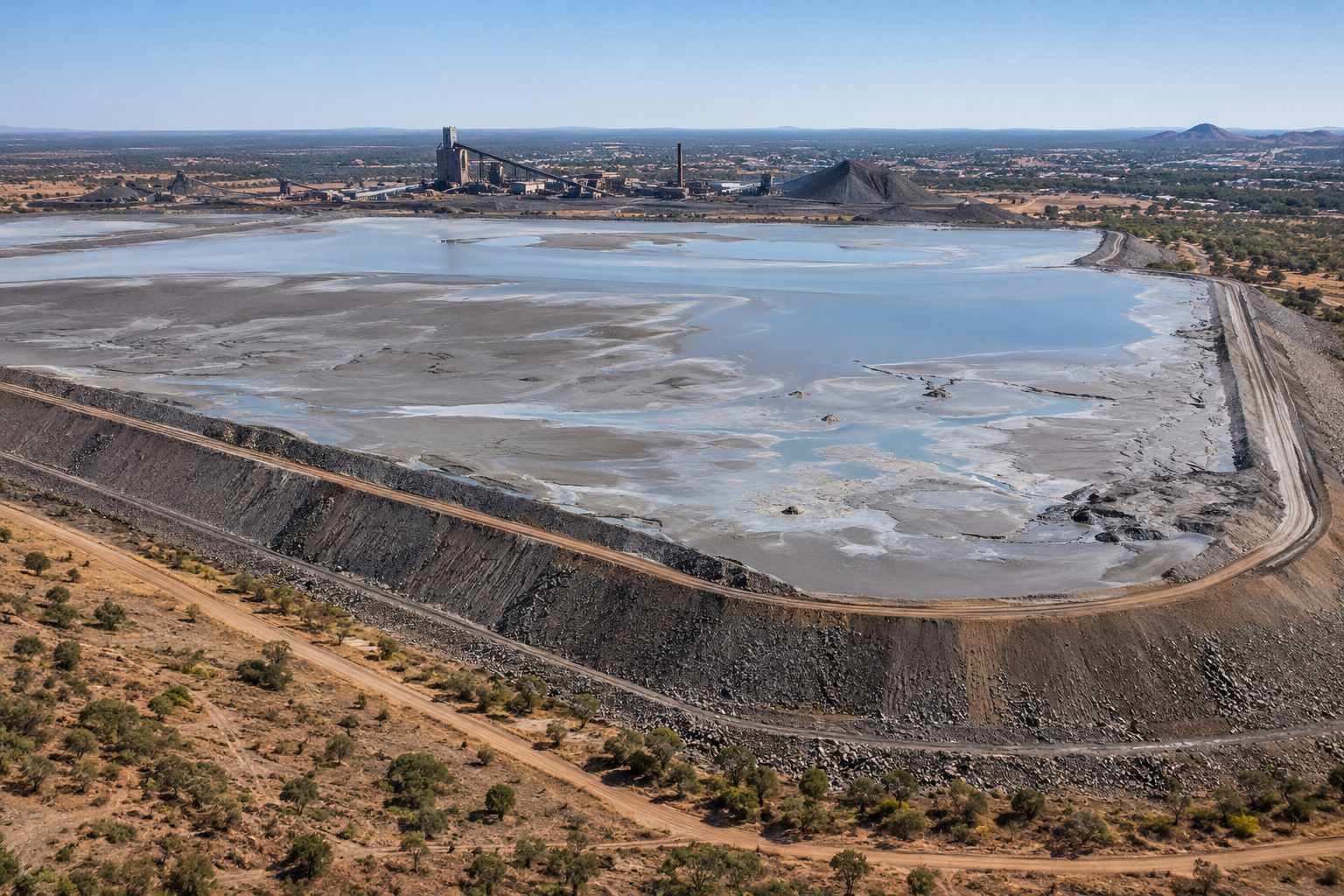
What are these tailings dams? These are dam-like structures used to store toxic waste generated by mining. Every mine produces tailings. According to the United Nations Officer for Disaster Risk Reduction, tailings are the fine-grained waste material left after extracting the metals and minerals recoverable from processed soil or rock. They are a common by-product of underground mineral extraction, often in the form of liquid sludge.
In Botswana, the Selibe Phikwe mine is estimated to have about four tailings dams that are sulphur-rich and acidic, a dangerous combination for the surrounding environment, people, and livestock. In 2024, scientists analysed samples of the tailings around the Phikwe mine and observed evidence of seepage through the slopes of the dams, which serve as pathways for chemicals leached1. They tested the acidity of nearby soils and found high pH due to sulphur leaching.
The findings are not surprising because the Selibe Phikwe mine is old. It has operated since 1973, meaning BCL has piled tailings and built new dams whenever old ones reached capacity, with no sustainable plans to recycle and reuse them. Tailings often remain piled for long periods without proper management or disposal, with no consideration for nearby communities, leading to heavy metals leaching into soils, contaminating groundwater sources, and causing other catastrophic pollution events. Water is scarce for many communities in Botswana, and groundwater sources are as precious as the diamonds the ground produces; toxin seepage puts many people at risk.
Around the BCL mine, scientists have observed what they call “dead zones”, where nothing grows. Yet mine companies are not held accountable for rehabilitation of the land, compensating farmers, or providing alternatives. Even though the Selibe-Phikwe mine is closed, it holds a record of decades of seepage contamination. People living in and around Phikwe are not safe as long as the inactive, likely zero-maintenance tailings dams remain. In 2010, a Mmegi article estimated the tailings sludge at the Phikwe mine at over 100 million to 45 million tonnes of dangerous, hazardous toxins sitting there and slowly seeping into the environment. Is anything being done to prevent the leach? Are the dams being maintained and monitored? Who is doing this, and under what regulation, is what communities need to ask.
The supposedly liquidated BCL mine is just the tip of the iceberg. The Global Tailings Portal records close to 100 tailings facilities across the country where mines are situated, and many have existed since the early 1970s, making them as old as Botswana’s mining history. According to the data disclosed by the mine company itself, the Jwaneng and Orapa mines’ tailings dams, which have been around since the early 70’s, have, between them, about 11; the former has four, and the latter has seven tailings storage facilities; these have been flagged by the listing company as contiguous. According to the Karowe Mine Public Disclosure Report of 2025, among its 3 tailings facilities, one has been closed because it has reached maximum capacity, evidence of the huge amount of slag mines produces. Yet in this disclosure, rehabilitation, community protection, and monitoring are futuristic, rather than urgent and intentional.
Given this threat, mining companies and governments must disclose to communities the danger these facilities pose. Communities have the right to know that tailings undergo physical and chemical changes; that the longer the deposit, the greater the changes, making them likely to harbour potent hazardous contaminants. Mining companies should disclose that tailings dams can fail if poorly constructed and maintained, and assure communities what preventative measures are in place. The 11 highly toxic tailings dams in Orapa and Jwaneng may be a disaster waiting to happen if the Botswana Government does not compel mining companies to maintain and monitor all tailings dumps transparently.
Over the last couple of years, civil society groups like the Southern Africa Litigation Centre (SALC) have raised concerns and even taken legal action against mine companies in Zambia after multiple tailings dams collapsed, releasing huge amounts of acidic, toxic waste into human habitats, poisoning waterways and soils, and destroying crops. Residents in these areas are suffering health and livelihood consequences from the mining companies’ reckless actions. Instead of fighting in court, mine companies must take responsibility by informing communities, seeking consent, and protecting them from the aftermath of their extraction. A recent study in Zambia after the tailings collapse showed that residents still live with these impacts long after the collapse, inhaling toxins, drinking contaminated water, and experiencing poor crop yields because the soil has been poisoned, while mine companies pack up and move on to another unsuspecting community.
Yet accountability against mining companies isn’t moving fast enough to protect these communities. Orapa, Jwaneng, Selibe Phikwe, and Lethakane communities must demand transparency and the power to make decisions about their own environment. This is the only land you’d ever have; fight for it. When community leaders are invited to tour the mines, as is usually the norm, in addition to seeking statistics on local youth employed by the mines, ask where the tailings facilities are situated, and about the safety precautions and seepage prevention measures. Civil society must demand tailings dams monitoring data from the mine companies and insist that mines pay for the damage caused by their actions.
Anna Mmolai-Chalmers is a human rights activist and a consultant at the Southern Africa Litigation Center (SALC)