
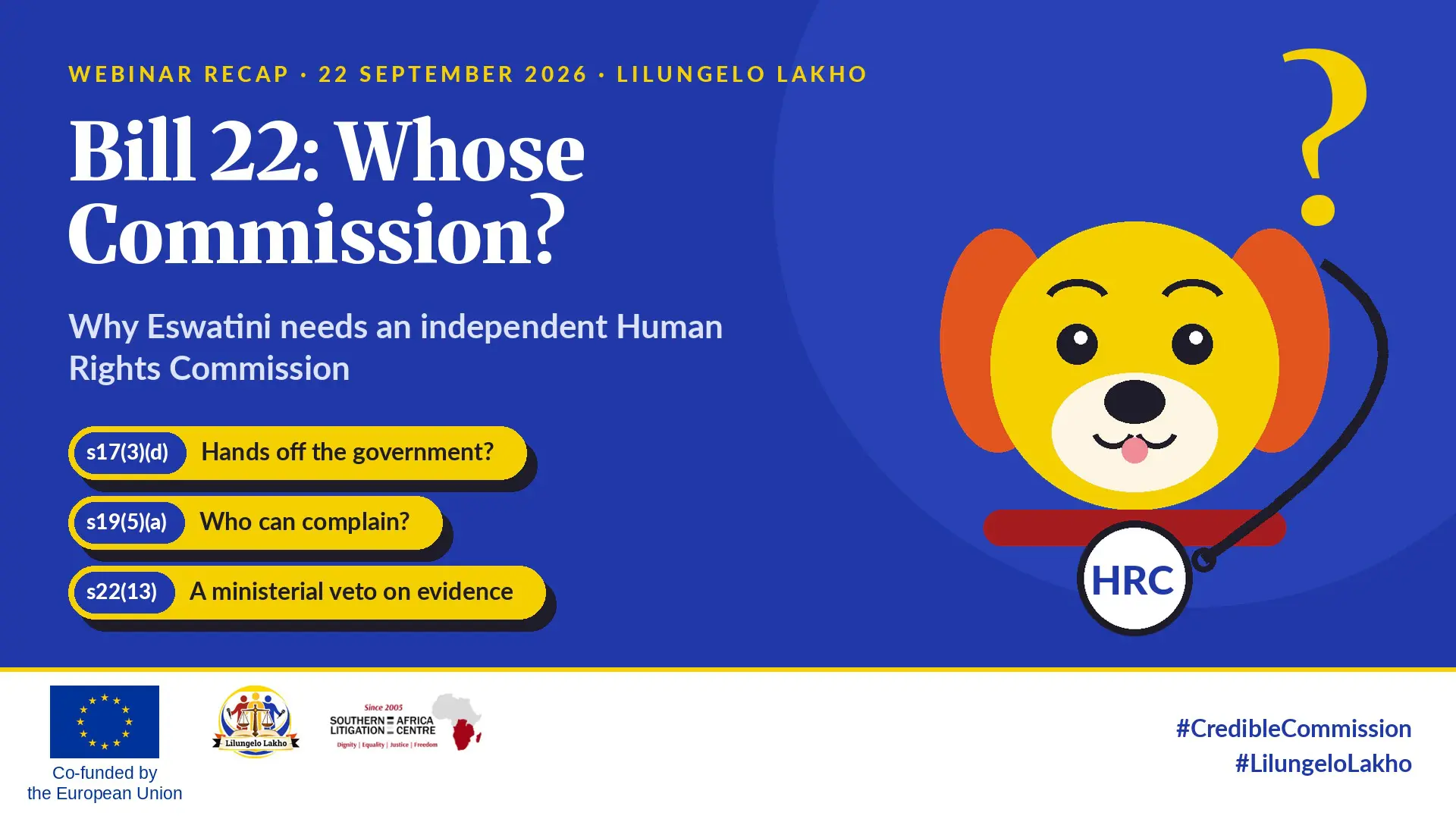
On 22 September 2026, the Southern Africa Litigation Centre (SALC), with its Lilungelo Lakho partners, hosted a public webinar on the Commission on Human Rights and Public Administration Bill (Bill No. 22 of 2025), now before Parliament. Panellists, including a former Commissioner of the Malawi Human Rights Commission, examined whether the Bill will give Eswatini an independent and credible national human rights institution.
Such an institution must meet the Paris Principles and be capable of accreditation by the Global Alliance of National Human Rights Institutions (GANHRI). Eswatini’s Commission has never been accredited.
What the Bill gets right
The Bill gives the Commission strong investigative powers, including the authority to visit prisons, police cells and other places of detention, with or without notice. These powers should be protected.
What needs to change
- Hands off the government? Section 17(3)(d) bars investigation of any matter connected to a Minister’s decision, a limit the Constitution does not impose.
- Who can complain? Section 19(5)(a) excludes migrant workers, asylum seekers and others in Eswatini for immigration or work purposes.
- Evidence veto: Section 22(13) allows the Minister to block evidence, even from complainants, without reasons or review.
- Funding: Section 26 funds salaries and administration, but not investigations, monitoring or regional offices.
- Reporting: Section 31 sends the Commission’s reports through the Minister, with no deadline for tabling them in Parliament.
- Appointments: Section 4 requires an open process but does not say what that means. Public nominations and interviews would strengthen credibility.
The Bill also lacks express protection for whistleblowers and people who come forward with complaints.
What you can do
Parliamentarians respond to the people they represent. Read the Bill, share these concerns with your Member of Parliament, and keep the conversation going in your community. An independent Commission is not a technical matter. It determines whether people in Eswatini have somewhere credible to turn when their rights are violated.
📄 Read the Bill:
This work is part of the Lilungelo Lakho project, co-funded by the European Union.